



Cherry Industries License Surrendered in Cannabis Regulatory Agency Resolution with Detroit Marijuana Grower
September 30, 2025 — The Cannabis Regulatory Agency (CRA) today announced a consent order and stipulation with Cherry Industries LLC (AU-G-C-000925), located at 6387 E. Nevada Street, Detroit, Michigan, resulting in the surrendering of their Class C Grower license.
On April 3, 2024, following an investigation, the CRA issued a formal complaint against the adult-use class C marijuana grower license (no. AU-G-C-000925) of Cherry Industries LLC for violating several provisions of the Michigan Regulation and Taxation of Marihuana Act (MRTMA) and its administrative rules.
During a routine inspection on November 15, 2023, CRA agents discovered Cherry Industries LLC had exceeded their legal plant limit. Additionally, numerous marijuana products, including immature and mature plants, buds, trim, and pre-rolls, were found untagged and not tracked in the state monitoring system. Further review revealed severe inventory tracking issues.
Cherry Industries LLC could not account for large discrepancies in both positive and negative package adjustments, amounting to thousands of pounds of marijuana product and thousands of units. Over 4,200 pounds of product recorded in the statewide monitoring system did not exist physically, and more than 41,000 pounds of wet weight from 115 harvests remained incomplete in the system. It was also found that Cherry Industries LLC had improperly mixed products from different harvests, transferred marijuana that had failed safety testing due to contamination with a banned pesticide, and sold contaminated pre-rolls to consumers.
Additional violations included improper batch sampling practices, failure to provide full access to batches for lab testing, and substantial noncompliance with video surveillance requirements. Although the CRA granted an extension for submitting surveillance footage, the Respondent ultimately provided incomplete and insufficient footage, including missing days, limited camera coverage, and hours-long gaps.
These findings collectively demonstrate significant failures in regulatory compliance, product tracking, safety standards, and operational transparency.
As part of the consent order and stipulation, Cherry Industries LLC license has agreed to permanently voluntarily surrender the license (effective ten days after the effective date of the order) and has agreed that it shall not be renewed, reinstated, reissued, or reactivated, limited or otherwise, at any future date.

CRA announces transition from paper licenses to digital format
Effective October 1, 2025, the Cannabis Regulatory Agency (CRA) will transition its Licensed Wall Certifications to a digital format. Once a license is issued, licensees will be able to log into their Accela Portal to access and print their digital wall certification for display. This change provides immediate access to wall certifications, allowing licensees to print or reprint their license at any time during the licensing period, and eliminates potential delays caused by USPS mailing issues. For more information and instructions, please visit https://www.michigan.gov/cra/


CRA Announces Historic Cannabis Compact Signed Between State of Michigan and Bay Mills Indian Community
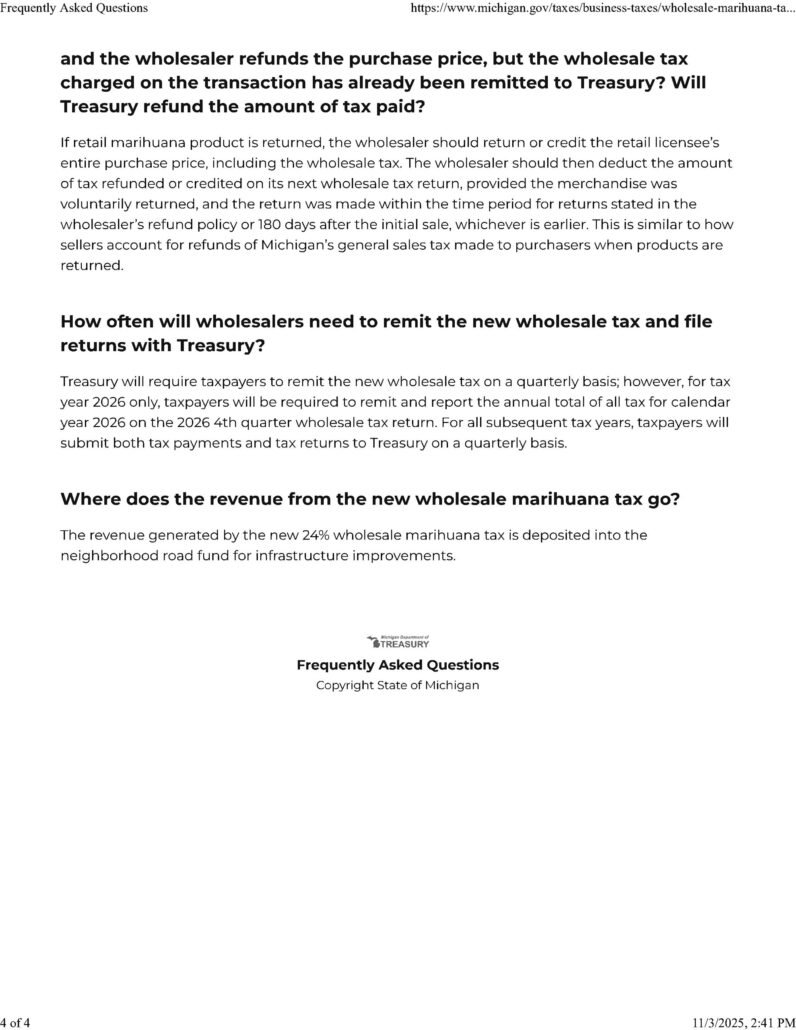
August 1, 2025 — In a historic development for cannabis policy and tribal sovereignty in Michigan, the Cannabis Regulatory Agency (CRA) and the Bay Mills Indian Community (BMIC) have officially signed the state’s first tribal-state cannabis compact, allowing the Upper Peninsula-based tribal nation to participate directly in Michigan’s licensed adult-use cannabis market.
The agreement, finalized on July 25, 2025, allows Bay Mills to integrate its Northern Light Cannabis Company into Michigan’s statewide Metrc tracking system and access the same wholesale and distribution channels as other licensed operators. The compact marks a major shift in how tribal and state governments can collaborate in emerging, regulated markets.
“This agreement reflects our shared commitment to safe, equitable, and well-regulated cannabis commerce,” said Brian Hanna, Executive Director of the Cannabis Regulatory Agency. “Welcoming BMIC into the regulated framework sets a model for tribal-state cooperation nationwide.”
“This compact represents a historic affirmation of tribal sovereignty and our inherent right to govern economic development on our own terms,” said BMIC President Whitney Gravelle. “We are proud to lead the way in establishing a framework for Tribal-State cooperation in the cannabis industry, one that respects self-determination, promotes equity, and opens the door for future partnerships grounded in mutual respect.”
BMIC was the first Michigan tribal nation to legalize adult-use cannabis on tribal lands in 2019 and launched its own tribally owned cannabis brand, Northern Light, in 2021. The company grows and produces organically cultivated cannabis at a vertically integrated facility in Chippewa County. Until now, its operations were limited to BMIC’s sovereign lands and the limited retail reach permitted by tribal law.
With this compact, BMIC will now be able to:
- Sell products, including flower, concentrates, and edibles, across the state through licensed distributors and retailers
- Participate in CRA-led compliance, testing, and inspection protocols
- Integrate into Michigan’s statewide monitoring system for full seed-to-sale tracking and consumer transparency
- Operate with the same privileges and responsibilities as other adult-use licensees statewide
The agreement creates a new category of participation in the cannabis industry for sovereign tribal governments in Michigan – one that respects tribal jurisdiction while aligning with statewide regulatory oversight. Importantly, the agreement allows the CRA to conduct inspections and audits, as well as monitor product safety and consumer protections, even on tribal lands, through mutual cooperation.
The tribal excise tax, along with statutorily required distributions from the Marihuana Regulation Fund, are expected to provide significant support to BMIC and its members as revenues will fund tribal infrastructure, education, public health programs, and economic development projects throughout the region.
Currently, 12 federally recognized tribes reside in Michigan, many of which have expressed interest in pursuing similar compacts. State officials and tribal representatives have both acknowledged that clear, legally binding agreements like this one are necessary to avoid jurisdictional confusion, foster consumer trust, and maintain a level playing field in a highly competitive and heavily scrutinized industry.
For answers to frequently asked questions about this agreement, click here.
About the Cannabis Regulatory Agency
The CRA oversees the regulation of cannabis in Michigan, including the state’s adult-use and medical marijuana systems. The CRA is responsible for licensing, compliance, testing, and enforcement. It ensures that cannabis operations meet the highest standards of public health, safety, and fairness.
About Bay Mills Indian Community
The Bay Mills Indian Community, located in Michigan’s eastern Upper Peninsula, is a federally recognized tribal nation and a long-standing leader in tribal economic development. In addition to cannabis, the tribe operates gaming, hospitality, and education enterprises and has a strong record of environmental stewardship and cultural preservation.


Notice of CRA public hearing on proposed updated Rules
Department of Licensing and Regulatory Affairs
Cannabis Regulatory Agency
Administrative Rules for Marihuana Rules
Rule Set 2023-25 LR
NOTICE OF PUBLIC HEARING
Tuesday, May 6, 2025
09:00 AM
In person: Sun Conference Room, 2407 N. Grand River Ave., Lansing, MI 48906
The Department of Licensing and Regulatory Affairs will hold a public hearing to receive public
comments on proposed changes to the Marihuana Rules rule set.
All rules will be effective 180 days after filing, except R 420.218a will be effective immediately upon filing.
The purpose of the proposed rule promulgation is to make various updates and revisions to the existing
Marihuana Rules, including updating, revising, and clarifying requirements pertaining to applicants and
licensees, the social equity program, the operation of marijuana businesses, production of marijuana
products, transporting and delivering marijuana, advertising and labeling, sampling and testing, use of
the statewide monitoring system, and annual financial statements.
By authority conferred on the Executive Director of the Cannabis Regulatory Agency by section 206 of
the Medical Marihuana Facilities Licensing Act, 2016 PA 281, MCL 333.27206; sections 7 and 8 of the
Michigan Regulation and Taxation of Marihuana Act, 2018 IL 1, MCL 333.27957 and 333.27958; section
3 of the Marihuana Tracking Act, 2016 PA 282, MCL 333.27903; and Executive Reorganization Order
No. 2019-2, MCL 333.27001.
The proposed rules will take effect immediately after filing with the Secretary of State. The proposed
issue of the Michigan Register. Copies of these proposed rules may also be obtained by mail or
electronic mail at the following email address: CRA-AdminRules@michigan.gov.
Comments on these proposed rules may be made at the hearing, by mail, or by electronic mail at the
following addresses until 5/7/2025 at 05:00PM:
Attention: Rules
P.O. Box 30205, Lansing MI 48909
The public hearing will be conducted in compliance with the 1990 Americans with Disabilities Act. If the
hearing is held at a physical location, the building will be accessible with handicap parking available.
Anyone needing assistance to take part in the hearing due to disability may call 517-643-0757 to make
arrangements.

FinCEN Removes Beneficial Ownership Reporting Requirements for U.S. Companies and U.S. Persons, Sets New Deadlines for Foreign Companies
Immediate Release
WASHINGTON––Consistent with the U.S. Department of the Treasury’s March 2, 2025 announcement, the Financial Crimes Enforcement Network (FinCEN) is issuing an interim final rule that removes the requirement for U.S. companies and U.S. persons to report beneficial ownership information (BOI) to FinCEN under the Corporate Transparency Act.
In that interim final rule, FinCEN revises the definition of “reporting company” in its implementing regulations to mean only those entities that are formed under the law of a foreign country and that have registered to do business in any U.S. State or Tribal jurisdiction by the filing of a document with a secretary of state or similar office (formerly known as “foreign reporting companies”). FinCEN also exempts entities previously known as “domestic reporting companies” from BOI reporting requirements.
Thus, through this interim final rule, all entities created in the United States — including those previously known as “domestic reporting companies” — and their beneficial owners will be exempt from the requirement to report BOI to FinCEN. Foreign entities that meet the new definition of a “reporting company” and do not qualify for an exemption from the reporting requirements must report their BOI to FinCEN under new deadlines, detailed below. These foreign entities, however, will not be required to report any U.S. persons as beneficial owners, and U.S. persons will not be required to report BOI with respect to any such entity for which they are a beneficial owner.
Upon the publication of the interim final rule, the following deadlines apply for foreign entities that are reporting companies:
- Reporting companies registered to do business in the United States before the date of publication of the IFR must file BOI reports no later than 30 days from that date.
- Reporting companies registered to do business in the United States on or after the date of publication of the IFR have 30 calendar days to file an initial BOI report after receiving notice that their registration is effective.
FinCEN is accepting comments on this interim final rule and intends to finalize the rule this year.


Covert Law Firm


Stacy Adams
6 years ago
Ashley was very professional and delivered highly favorable results. I felt peace of mind knowing I was in the very best hands during one of the most challenging times in my personal life. Highly recommend .

Erick Roberts
6 years ago
Josh really cares about his clients. He has personally helped me multiple times on (2) separate cases. Criminal law & cps are two expertise areas i have personally witnessed. Josh has also worked wonders for a close friend of mine in the MJ field. If you are reading reviews or trying to decide if josh is the guy you need, you are looking in the right spot.

Colorado Ski Chairs
6 years ago
One of the smartest and most dedicated guys you’ll ever meet. Joshua has helped innovate and push the boundaries of modern justice in not only the medical marijuana field but in social justice and protecting and supporting families. He’s one of a kind. Fair, dedicated, intelligent and tireless. You’ll be pressed to find a better ally for any case you need help on.

Patrick Giddis
6 years ago
Joshua Covert has been extremely helpful and personable. Rare to find lawyers that will try to help no matter whether you retain them or not. I've dealt with a lot of lawyers but he's one of the most honorable.

Gee Rod
6 years ago
I first hired Josh last year for a criminal assault case in Clinton county. I decided to take that case to trial. I had a NOT GUILTY verdict in less then five minutes after deliberation. Since then I've continue to use Josh for numerous things. I am highly involved in the cannabis industry and Josh had my five year state wide noncompete agreement thrown out just last month. Josh and James have also helped me get my medical and recreational licensing for both grow and processing in the city of Lansing. They did all the trademarking for all my brands and logos. I am also using Josh for some other legal things that he doesn't specialize in like estate and will. I have utmost confidence in his abilities and I trust him. Josh and his team are really the best when it comes to law. I've put them up against big money a few times and came out on top. Josh and his firm are honest and hard working. If he doesn't know the answer to something he is sure to find it for you. You can't get much better then the Covert law firm. Highly recommended!

Joe Dunn
6 years ago
About two years ago, I was interested in the smaller commercial marijuana cultivation licenses in Michigan. I had many questions regarding the application process and understanding/clarification on the laws surrounding the commercial grows. I called Josh after getting his number from google. He answered my questions, but I had many more and I also needed help with the application process. He told me to move forward, I would need to deposit $2,000 and open an account with him. This would allow me to call or text him for quick questions and responses. I didn't think I would have $2,000 worth of questions, but he assured me, over the phone, that if I didn't have any more questions I could get money back that I didn't use. Fast forward to present day, I no longer need his services. I have $1,555 in my account. $445 was deducted for text and phone call questions that I have had over the past years. I reached out to him 4 weeks ago, to get my $1,555 back. First he tells me its non-refundable. I reminded him that he told me I would get any money back that I didn't use. After going back and forth, he agreed to give me my money back. 2 more weeks pass and nothing. I reach out to him again, he tells me he doesn't write checks, his assistant has to do it, blah blah blah. He tells me I will have it in a few days. That was 3 weeks ago. I still haven't got any money back. Not a word from Josh. DO NOT USE THIS LAW FIRM. DO NOT TRUST THIS GUY. If you do, make sure to audio record all conversations with him!!!! He will lie to you to get you to pay large deposit for services you dont need.

Kate Seward
6 years ago
In the beginning of my case, Ashley talked to Josh. Josh and Ashley told me I have nothing to worry about in the child custody case. Total took a lot off of my shoulders hearing that. Thank you to you both for traveling to Roscommon County for this case! You both rock and ready to be a bull in court in Nov. Thank you again!!

James McGillie
6 years ago
Best in the business. Client focused, responsive, and effective team of attorneys with practical advice and solutions to most any legal issue you face. HIGHly recommended 👊

Nicole Abbey
6 years ago
Covert Law is a law office that cares about the individuals they represent and are affordable. Josh will get it done!


Sara Eleanor Yarbrough
6 years ago
Although I was facing some serious things, Josh happily took my case and was there every step of the way. The retainer was very reasonable, communication was great, and his negotiations were very clear and to the point. He really made an intense, sometimes scary and emotional, situation a lot easier to go through. I never felt like he was trying to get money out of me. I can honestly say my outcome, and life going forward, is much easier from choosing to call him for legal aid.

Sam Postalot
6 years ago
Very knowledgeable always a pleasure to work with highly recommended been in the industry for years

Tony Nowak
6 years ago
Very professional, knowledgeable and willing to help point me in the right direction.

Randi Bagley
7 years ago
Excellent concise and knowledgeable, especially about medical marijuana. Call them if you need advice! They are very fair and generally want to help the cannabis community.

Chris C
8 years ago
Nickolas Calkins was recommended to me, and ever since the first time I to him I was in good hands. He was able to handle the case and help relieve the stress from it off of and communicate in a way that kept me at ease and well informed. He, and the entire staff at Covert Law really went above and beyond. I am grateful that I was introduced to them.

Roy Schmidt
8 years ago
Josh Covert is the best cannabis attorney in Michigan. Josh defended me on an OWI charge, operating while impaired on cannabis. Josh was outstanding in my defense. Josh is a good listener, kept me updated, asked my opinion, and really cares about his clients. Josh filed every motion (several) in my defense before my trail. During the trail Josh was professional but a bulldog in defending me against lies and lack of evidence by the arresting officers. When Josh was finished cross examining the arresting officers it took a jury less than an hour to find me NOT GUILTY! You will never go wrong with Josh Covert.

Vessel of Christ
8 years ago
Hands down the best Attorney in Michigan, cares for his clients, knows the laws, doesnt back down, and doesnt get pushed over like most attorneys by the corrupt system and corrupt prosecutors. This Job is meant for truly intelligent people that have a heart for truly helping the individual, and out of 15 different attorneys that I've had in my life. There is no comparison. When you truly know you have someone on your side, it takes away the fear the corrupt system wants you to feel

brian coon
8 years ago
I hired josh on my open case but he's been a good attorney, very , very knowledgeable on cannabis and cannabis laws.he's also will work with you. I feel if ur in need of a tip notch cannabis attorney I wouldn't look no mores and give his office a call.very good ppl in office also..thanks Josh !!!

Jennifer Dummer
8 years ago
Josh Covert is an amazing lawyer. He fought for us and got our case thrown out. I would highly recommend him. He's always there for us when ever we need advice or help.
